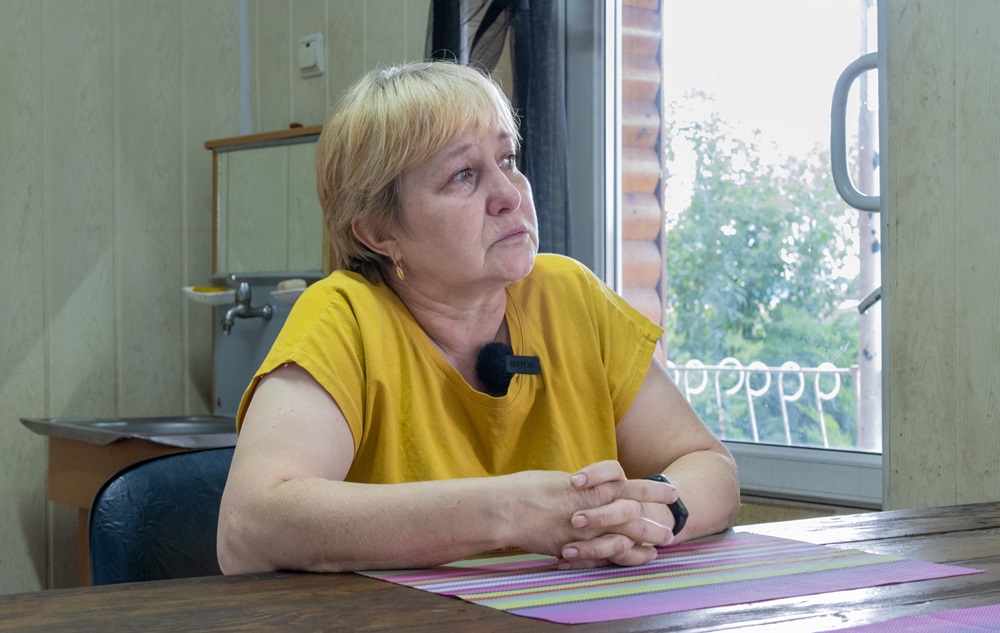
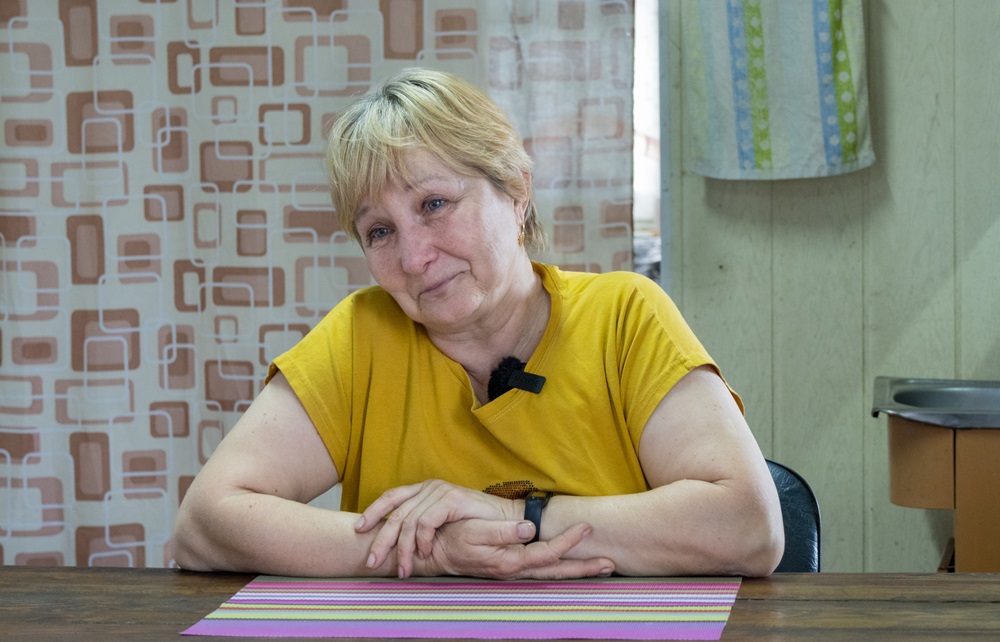
I didn't plan anything for the 22nd year. It's just that my mother died, we buried her on the 23rd [in the Kyiv region], and we were here on the 24th.
The children called us in the morning and said that... We left here at four o'clock in the morning because the animals stayed here. I have a big dog here, cats. When we were driving along the highway, no one was going in this direction, but there was already a stream coming from here. A large flow of people, some on foot, some in cars.
When refugees from Chernihiv and nearby villages began to gather to us, I already realized that there was really a war. First of all, there were products in our store, we could somehow still dissolve something. When the bread ran out, they began to understand that people come to us and ask – bread, bread, bread. Then my husband and I decide and negotiate with the Chernihiv bakery. They say: "If there is an opportunity to come to us by car, then go, we will give you as much as we can give".
We take, thank the local people (people started bringing humanitarian ‒ milk, cottage cheese, potatoes, carrots, beets to us), we put everything in the car and go to the bread factory. We give food to volunteers, take bread and, while we go back, distribute it at checkpoints.
And we went to the last one in Chernihiv, until my husband was killed near Yagodny after the little God. There, the bullet passed literally centimeters from the head. He took a woman and a child from there, a man wounded in a car and three boys. And this was our last trip to Chernihiv. Then I contacted my daughter in the Kyiv region and said: "Yes and yes, we have such a problem that we don't have bread". How to say, everyone knew our family well there, they knew me well [we are talking about a town in the Kyiv region]. I worked there in a store for more than 10 years as a salesperson. And we started looking for contacts, there is a temporary bakery.
We came there, we came to the bakery. Agreed. The first time we brought, in my opinion, 600 loaves of bread. They just stuffed him into the car as soon as they could stuff him. We load the bread and they give it to the debt. We agreed with the director that we are taking bread, for example, we are coming on another day, we are taking bread and bringing money for the previous batch. This is how we had it. Because the car does not ride in the air, it was necessary to refuel for something.
We bring bread, and here they start running: Nadinovka, Vovchok, Seredinka, and the military... The boys were standing in the villages, we handed the bread over there. This was not even discussed, because bread was simply given to the Armed Forces.
Even the girls who worked in our kitchen got a little angry with me. I'm on my way, they say, "Take something, eat something". And I don't have time, people are already waiting for me there, I need bread. She could somehow grab a piece of bread on the way. We will tear this bread for two with the driver, this is all I could eat in a day. I have never had such good bread as it was at that time.
We still went for meat. At the late godfather, the nephew ‒ director of the complex, we could agree with him to take 6, 7 pig carcasses as well. They went together with their husband, manually sank these carcasses, brought them here. No one asked us, people just came to us, they had to be fed.
We somehow understand ‒ from a half word as much as each other understands. He is just a beaten Afghan. That's how I understood everything.
Our communications are so high that the lights were not turned off. While the gas cylinder was, people were fed. And then a rough brick was placed on the territory, boilers were taken and boiled, and food was prepared. Later, the boys came to us and put a field kitchen on the territory. This was the situation. Buy ‒ showers are. Although it is primitive, nevertheless, the water in the boiler warmed up, and the boys were given the opportunity to swim. We all washed things here. They brought me bags, washed the washing machine, hung it, dried it, gave it away.
Refugees. You know, they just asked to warm up to put at least a little children. There were families with such small children, two-year-old children. And the little ones were like that. Then, of course, we contacted the village council. They tried to place them somewhere, to transport someone somewhere. If possible, they settled here.
People came to us almost every day: they spent the night, they left, they arrived, they had to be taken somewhere on the highway to be taken to Kyiv. They slept on our refrigerator, on tables, on the floors of mattresses.
For two months, I had no connection with my child at all. Even when she broke out there to her home, we had already met. And so we had practically no connection with her. My daughter was very worried about me. He says: "Mom, I didn't know if you were alive or not". Because the way they passed for Chernihiv... They said that we were generally tough here.
We had such a situation when people were brought from Krasny. A woman (50 years old somewhere) came in with a boy, and a boy was one and a half years old. She cries and says: "My child was killed. I wrapped my daughter in a blanket and buried her at the end of the city. This granddaughter survived".
And when you drive along the road, you realize that the boys have frostbitten faces, frostbitten fingers, and no warm clothes. We once went to Chernihiv with my husband. And the boy is standing, he has thin pants, some kind of light jacket and that's it. The frost is crazy in the yard, and the wind is crazy.
We had some things in the man's car there: a sweater, a jacket. And we pulled it out and just gave it away. This is scary. No matter who we are?
link to history